Home About Recipes Artisans Blog Notes Resources
Showing posts with label Christmas. Show all posts

Saturday, December 8, 2012

Christine Ferber's Beraweka

I already knew Christine Ferber for a master confiturière (jam-maker). I have her book, Mes confitures (now available in English), which I consider my jam bible. I do own a handful of other jam books accumulated over the years but if I were to be sentenced to a desert island and could only take one with me, hers would be the one: the flavor combinations are spectacular and the recipes spot on. I also like the fact that the book is organized by season. Needless to say, in my part of the world, the chapters that get the most mileage are summer and fall but if the above-mentioned desert island involved a tropical clime, I wouldn't mind putting the winter chapter to the test (hello, pineapple, banana and coconut jam!).
What I didn't know and learned from my favorite French radio food podcast (in an episode broadcast live from Strasbourg a year ago and available on the web until September 2014) is that Christine Ferber is also a celebrated pâtissière-chocolatière-confiseuse (pastry-chef, chocolate maker and confectioner), that she owns a pâtisserie (pastry-shop) near Colmar in the Alsace region of France and that every year she makes a sumptuous traditional Alsatian holiday bread, the Beraweka, also known as Beerawecka or Bierawecka or Birewecke.
The origins of the bread (traditionally enjoyed at Christmas with a glass of vin chaud - hot mulled wine -, Gewürztraminer or Riesling vendange tardive (late harvest Riesling) upon returning home from midnight mass) are a bit unclear: some believe Beraweka to be as old as Alsace itself (Beera meaning "pear" and Wecka "bread" in Alsatian) while others think it was brought to the area by the once vibrant Jewish community as a traditional Passover dessert (bere meaning Pessa'h in Yiddish). In the Jewish version, it requires plenty of dried fruit but no pears and it remains unleavened.
There seem to be as many recipes as there are spellings for Beraweka: some call for dried apples; some require scalding all the dried fruit before soaking it in kirsch; some replace almonds with hazelnuts. The variations are endless. In Christine Ferber's village of Niedermorschwihr, the bread is traditionally made at home from a recipe handed down from mother to daughter since the sixteenth century. She feels very fortunate because her fellow villagers still honor the age-old tradition of bringing their holiday breads to the baker for baking, which means that each December she gets to experience many different Berawekas.
Winters can be long and harsh in Alsace and drying fruit has always been a favorite way of making sure summer bounty would remain available throughout the cold and dark months. Ferber says she starts drying pears from nearby orchards in August. She chooses barely ripe sweet pears, cuts them in half, removes the core, and cuts eight slices out of each half. She puts these slices on racks in the oven and lets them dry for eight hours at 70°F/158°C. She stores the dried fruit in a dry spot away from the light. She also dries her own questches (damson plums).
Christine shared her recipe with the audience. I have translated it below, with some modifications. Many Alsatian Beraweka recipes use regular bread dough. Christine's uses brioche dough. Since the amount of dough is minimal (just enough for the fruit to stick together), the bread never dries out and keeps forever. Christine says she still has some at home that she made five years ago. I wasn't planning on making brioche, so I used a bit of levain-based sifted flour dough I had just proofed for another recipe. It turned out just fine. I doubt I'll have enough left over to test the five-year shelf life though...
Christine also uses two different kinds of anise when I only had one sort: rather than using more of that one, I replaced the other one by a good pinch of mixed baking spices. Finally since there were no pictures of the Beraweka on the podcast's webpage and I couldn't find attractive ones elsewhere on the web, I didn't know what it was supposed to look like. Looks-wise, mine certainly didn't end up like a winner but when I bit into a slice, I felt transported as by magic to a faraway place and time that tasted just as Christmas does in dreams.
Pierre Hermé, the renowned pastry chef and macaron all-time wizard, has been friends with Christine Ferber for more than forty years (his mom is from the same village). According to him, her Beraweka is one of the five products that should be on everyone's bucket list (he didn't actually use the expression "bucket list" but he did say it was one of five products everyone should taste at least once in his or her lifetime). I don't know if I'll ever make it to Niedermorschwihr but at least I have Christine's recipe and now so do you. Christine said it herself, the bread really isn't difficult to make. It only requires a bit of time and patience. As for another Alsatian Christmas favorite, the Stollen, she said the best she has ever had was Pierre Hermé's (who got the recipe from his own mother). 

Ingredients (for two breads)
(Note: Christine actually makes four 250 g-breads with this recipe. Since I didn't soak the pears in water, I ended up with a lighter"dough"which I decided to divide in two)
  • 100 g dried pears (Christine soaks hers for 24 hours in 500 g hot water. See Note, Method, step 1)
  • 100 g dried plums, pitless (in the absence of Damson plums, I used California dried plums, also known as prunes)
  • 100 g dried figs (I used small black mission figs)
  • 100 g dried apricots (I used unsulphured ones)
  • 100 g raisins
  • 50 g kirsch (to which I added another 50 g for a total of 100 g)
  • 50 g candied lemon, slivered (home-made would be preferable to store-bought and certainly closer quality-wise to what Christine has available to her in Alsace but it is an extra-step and if it prevents you from giving the bread a chance, it isn't worth it. I used candied orange and lemon that my friends from Tree-Top Baking kindly gave me. Next year if I get my act together early enough, I might try making my own)
  • 50 g candied orange, slivered (same remark)
  • 40 g walnuts, roughly chopped
  • 40 g almonds, peeled (mine were pre-sliced)
  • 5 g green anise (I used regular ground anise seed)
  • 5 g baking spice (a mixture of cinnamon, mace, anise and cardamom) (Ferber uses ground anise seed)
  • 100 g brioche dough (or any other bread dough you have on hand), divided in tiny pieces
  • walnuts and almonds for decoration (I skipped that step)
Method: (the bread is made over three days but requires minimal intervention until the third day)
  1. On the first day, scald the pears and let them soak overnight (Note: I did that and my pears -which were fairly tender to begin with - ended up way too soft). So, as an alternative, if your dried pears are almost tender enough to be eaten straight out of the bag, just slice them into slivers on the second day and add them to the bowl with the other fruit
  2. Soak the raisins in the kirsch and let them macerate overnight
  3. On the second day, sliver the figs, apricots and plums. Put these slivers together with the pears and the raisins in a large bowl
  4. Add the candied lemon and orange and leave to macerate overnight, covered (that's when I added the extra 50 g of kirsch since I wasn't using the softened pears)
  5. On the third day, add the spices, the walnuts, the almonds and the little pieces of dough
  6. Mix until everything sticks together
  7. Pre-heat oven to 300°F/150°C
  8. Wet your hands and shape the breads as small bâtards
  9. Set on a parchment-paper baking sheet and bake for one hour (Christine didn't mention proofing but I didn't feel comfortable going straight from mixing to baking. So I set the baking sheet inside a tightly closed clear plastic bag and gave it an hour. I could see no appreciable difference in the size of the breads but maybe the levain still worked a bit of its magic)
  10. Bake for one hour
  11. Cool on a rack (Christine doesn't say to glaze the bread but I did. When it came out of the oven, I brushed it all over with a bit of confectioner's sugar diluted in two tablespoons of kirsch and a drop of boiling water. It made it all shiny)
  12. When cool, wrap tightly in plastic wrap and wait at least a week before eating
  13. Enjoy!

Pre-soaking

Post-soaking

Pre-baking

Post-baking

The Beraweka is going to Yeastspotting, Susan's weekly round-up of breads.

More info: If you read French, you might enjoy this interview of Christine Ferber for Le Journal des femmes). 

Friday, December 23, 2011

Swedish Thin Bread

I have had a (huge) soft spot in my heart for Scandinavia ever since my beloved late mother-in-law Sigrid -who hailed from Charlottenlund near Copenhagen- introduced me years and years ago to the magic both of white summer nights and of Nordic Christmases. Juleaften (Christmas Eve) was her favorite holiday. She didn't bake or cook but she filled our house with lights and love and I will cherish these memories for as long as there'll be Christmas. So when Eva and Valter, our Swedish friends, invited us to a pre-Christmas bake party, my imagination (never idle) brought me back to these winters of long ago when I used to dream of snowy lakes and red cottages with glimmering windows and my heart immediately skipped a beat.
The thin breads are not part of the Danish tradition (at least not as I know it through Sigrid) but the elves (julenissen) very much are and the minute I stepped inside the Swedish bake house and saw these little creatures on the wall, I knew I was in the right place. Turns out, the elves were not only on the wall. They were rolling out dough, talking, laughing, snacking, tending the oven, counting seconds (it takes exactly 11 seconds to bake a thin bread in a wood-fire oven) and sipping glögg (mulled wine).
We joined right in and a few hours later, with floury aprons and much good cheer, we all emerged from the baking house with armfuls of flatbreads. These will be enjoyed with smoked salmon, lox or crab paste, cheese, jams or just plain butter all through the holiday weekend and even later since the habit is nowadays to freeze whatever isn't eaten immediately.
In the old days, families and friends met a few times a year to bake this bread, not only at Christmas time. So when the owner's family moved from northern Sweden to the Northwest, they had a brick oven built in a little house in the backyward and it became a tradition for the neighborhood Swedish immigrants (there were quite a few in the old days) to meet there and bake. The tradition has survived the generations and today the bake house is still very much in use.
The thin breads can only be made one at a time in a woodfire oven. They are never flipped, just rotated to ensure an even bake. The dough is typically mixed at home and brought to the bake house at the appointed time (families book oven time long in advance).
It is then scaled, rolled out (with lots of extra flour as it is pretty sticky), flattened into round pancake-shaped loaves, thinned out with specially grooved rolling pins, brushed to remove any flour which might still be clinging to the dough and then deftly lobbed onto the oven sole in front of the flaming wood. They are folded immediately while they are still hot. (I hung a few on my pasta drying rack to dry out completely when we got home as condensation had accumulated in the Ziploc bags. As soon as they were perfectly dry, I packaged them again).
What follows is Eva's recipe. Thank you ever so much, Eva! I used a blend of light rye and white whole wheat flour but I'd be tempted to add oat, barley or buckwheat flour next time or maybe use dark (whole) rye, just to vary the taste as the Swedes apparently like to do.

Ingredients (for 30 large thin breads):

  • 2.5 liters of milk
  • 19 g instant dry yeast (28 g active dry)
  • 5 g baking powder
  • 56 g butter
  • 130 g sugar (I might skip the sugar next time and that may sound like heresy to a Swede! I'll have to ask Eva)
  • 210 g syrup (I used maple but you can use any pancake syrup or a mix of molasses and syrup)
  • 13.5 g salt (I will use 2% of the flour weight next time as we like our breads a tad more salty)
  • 1815 g unbleached all-purpose flour
  • 913 g light rye flour (or a mix of rye and whole wheat flours)
  • 11 g ground fennel seeds (Eva leaves some fennel seeds whole or barely crushed)
  • 11 g anise seeds
Method:
  1. Mix all dry ingredients with hand or a wooden spoon
  2. Warm milk, butter and syrup to 120-130°F/49-54°C
  3. Mix everything together in a large shallow bowl
  4. Let it rise, covered, until needed (I gave it one fold as it looked really batter-ish)
  5. Divide into 30 pieces and proceed with the shaping and baking as per video above.


Happy Holidays!

The Swedish Thin Bread is going to Susan for Yeastspotting, her weekly roundup of breads and other baked goodies.

Monday, December 19, 2011

The Bashful Bûche...

...also known as the bûche of Christmas present and maybe future! See, when I was growing up, the bûche de Noël (yule log) was a big event in our family. My Mom made it from scratch year after year. We kids saw it as the pinnacle of the Christmas dinner and awaited it eagerly. For the filling and the frosting, she made "crème au beurre" (butter ganache) which she flavored with strong coffee. She always decorated her bûche the same way, with a plastic Santa hoisting a bulging backpack of presents, a little sled pulled by two reindeers as well as a few elves and a couple of mushrooms, including a gigantic red one with white polka-dots. Pretty tacky stuff but magical to a child!
I inherited the decorations when my Mom stopped making Christmas and used them on our own bûche when our kids were little. But then slowly but surely after decades of loyal and cheerful yearly service, the red faded, the big mushroom cap assumed an awkard angle that no amount of tweaking seemed to fix for long and the reindeers lost their footing. I regret to say that they all had to be retired... At about the same time I stopped making the dessert and my Mom's bûche suddenly morphed into the bûche of Christmas past.
This year, despite the lack of plastic Santas, elves and reindeer, I decided to pick up the tradition where I left it years ago but with a self-imposed twist: no butter and as little egg as possible. Why? Well, I am not a card-carrying member of the nutrition brigade but the fact is that the Man has to watch his cholesterol levels and since his ruling principle is that whatever I make or buy is good for him or I wouldn't make or buy it, I find myself looking for alternatives which I would never consider left to my own devices.
See, I am lucky enough to have inherited my Dad's cholesterol gene. He was the living embodiment of the French paradox, never having met a saucisson (dry cured sausage) or a pâté he didn't like and until his last day, he never let water touch his lips except when brushing his teeth. As for me, I remember going to a new doctor for a check-up back in New York a few years ago. She glanced at my lab levels and did a double-take, then got up from behind her desk and walked to her bookshelves, coming back with a huge medical volume. She thumbed through it for a minute, then her brow cleared: "You are okay, it seems. It's just that I have never seen such a low level of cholesterol in a living person!"
Well, my Mom wasn't so lucky and neither is the Man who pretty much likes everything that's garanteed to stick to his arteries. His take on his health reminds me of a conversation I once had with one of our grand-daughters. We were traveling in the car in a driving rain when she glimpsed beckoning golden arches. She said wistfully: "I love chicken nuggets. It's my favorite food!". Crestfallen, I observed that it was okay to have them once in a while but that they were not really good for one's body. She replied sharply: "Maybe they are not good for your body, but my body loves them!". She had just turned 3.
So even though I think that, barring compelling health reasons, it is okay to eat whatever one likes from time to time, when I resolved to bring the bûche back to our Christmasses, I looked for one that would go where others fear to tread and entirely eschew butter. The one I found on the Eating Well website fit the bill. It used lots of egg whites and only two yolks and the cake itself looked superlight. I decided to go for it.
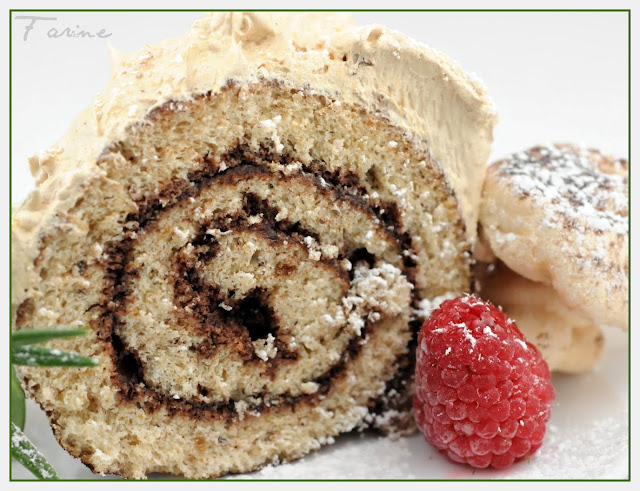
One roly poly, a meringue mushroom patch and mountains of frothy frosting later, I do declare a winner in the bashful bûche pageant: the cake is light and the taste delicate. I love the combined flavors of roasted hazelnut, chocolate and coffee and best of all, the whole thing is as airy as a cloud, which is a pretty nifty trick for a log.
I followed the recipe to a tee but for this clever log to become the bûche of Christmas future, I would change a few things:
  • I would set aside one-and-a-half to two cups of frosting for the filling. The recipe calls for one cup but I had barely enough to cover the cake. Despite my painting the cake with a blend of coffee and hazelnut liqueur before filling it, it turned out drier than it should have;
  • I would make the filling more chocolaty. I used Valrhona cocoa which should have be strong enough but it wasn't. I would melt some good dark chocolate, let it cool and gently fold it into the frosting, creating some kind of superlight chocolate mousse;
  • Finally I would make the coffee-flavored frosting darker and slightly more assertive by using more concentrated coffee.
Once that's done, I think even my Mom would agree that the Bashful Bûche is a keeper. Now all I need is a new plastic Santa, a few elves and a pack of reindeer. I think I have the mushroom situation under control.
 

Blog Designed by: Deanna @ Design Chicky