Home About Recipes Artisans Blog Notes Resources
Showing posts with label Richard Miscovich. Show all posts

Wednesday, August 27, 2014

The Grain Gathering 2014: Wood-Fired Artisan Bread with Richard Miscovich

Richard Miscovich is the author of From the Wood-Fired Oven: New and Traditional Techniques for Cooking and Baking with Fire, a book you definitely want to check out if you haven't read it yet, even if you don't have access to a WFO (as is my case). WFO owners will love to find out how to make optimal use of their oven's heat cycle and serious home bakers (or anyone wishing to bake bread at home) will treasure the wealth of information it offers on mixing, fermenting, dividing, proofing, etc. I like it that the book is never dogmatic and that the reader feels Richard's presence every step of the way. In the fall of 2011, I had the privilege to attend a BBGA class he taught at Johnson & Wales University in Providence, Rhode Island (where he is an associate professor at the College of the Culinary Arts) and I remember being awed both by his teaching and by his baking. Needless to say, when I discovered he would be doing both at the Grain Gathering, I made a beeline for his workshop (although I unfortunately had to leave smack in the middle to attend a talk on natural leavening). The linearity of Time is indeed the scourge of the human condition, isn't it?

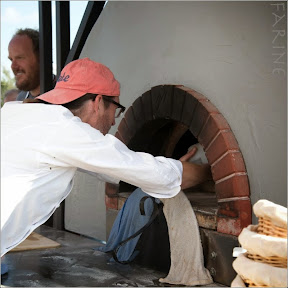
I love to watch professionals score their proofed loaves. It always reminds me of dancing. The movement starts before the lame (or blade) even touches the dough. As Richard explains in his book, "Ideally, the motion is continuous, with the moving blade cutting neatly through the dough and continuing on its trajectory." Another baker I know phrased it differently but the idea is the same: "The lame has to hit the ground running!"
 
The bread was 40% whole wheat. As you can see from the images below, it turned out beautifully even though it started over-proofing a bit out in the warm air: if you let your dough over-ferment, the yeast uses up all the sugar and there will be no caramelization. So the proofing baskets had to be carried back all the way through the orchards to the retarder in the lab and brought back out again when the oven reached the right temperature. Fermentation does go more quickly with whole grain (the bread was 40% whole wheat), a wet dough (hydration was at 82-85%) and warmer temperatures.
Richard uses a garden mister to steam his oven. Someone asked how much steam to use. The answer: "You know there is enough steam when you can no longer keep your hand inside the oven to add more!" It is important to bake in a humid environment because the bread expands more, the score marks open more fully and you get a really good color with shine. If you bake at home and don't have a wood-fired oven, Richard recommends using a cast-iron combo cooker or to bake on a hearth stone or a sheet pan with a large metal bowl inverted over your loaf for the first twenty minutes.
 
For those of us who can't get to his classes, Richard mentioned he had a video out on Craftsy, Hand-made Sourdough - From starter to baked loaf. I haven't seen it yet.

Monday, August 25, 2014

The Grain Gathering 2014 : In the garden of Eden

The 2014 Grain Gathering (formerly known as the Kneading Conference West) took place last week on the gorgeous grounds of Washington State University Agriculture Research Center in Mount Vernon, Washington. It was the fourth of these events and as we now live in California (I had sent in my registration long before I knew our move would be a done deal by the time mid-August came around), I truly thought, before flying up, that this one would probably be the last one for me.
After all, I do get it: eat locally and seasonally, be gentle with the landscape by favoring organic or at least environmentally friendly agricultural methods and always remember that farmers need to make a living too (after all, if there were no more farmers, there'd be nobody between us and Big Food, a thought too scary to contemplate). So I had more or less convinced myself that this year's event would be mostly a rehash and that having attended the first four ones, I was done!
Well, I am happy to say that I was wrong and that I flew home with dreams of the fifth Gathering dancing in my head! The name of the event was changed from Kneading Conference to Grain Gathering because, as Steve Jones (wheat breeder and Director of the Center as well as of the Bread Lab) puts it: "Nobody kneads anymore." Plus bakers are not the only ones interested in grain: farmers, millers, breeders, brewers, etc. flock to Mount Vernon as well. In fact, more than anything, the "gathering" dimension is what will keep me coming. I love the energy and dynamics of encounters with participants from all over (twenty American States, three Canadian Provinces, the United Kingdom and South Africa.) I love it that bread isn't the only focus, that classes, lectures and workshops on milling, malting, brewing, breeding, building earth ovens, transforming a stationary bike into a grain mill, etc... are all mobbed as well.
For an idea of the scope of the Gathering, you may want to take a look at the schedule. In an ideal world (where Time wouldn't exist or if it did, wouldn't be linear), I would have attended all classes, lectures, tours and workshops concurrently but as it is, I had to choose. So I forewent production baking (even though the workshop was run by two bakers I greatly admire, Mel Darbyshire from Grand Central Bakery in Seattle and Scott Mangold from Breadfarm in nearby Bow-Edison), the roundtable on the farmers' perspective, the one on milling and nutrition, the tour of the orchards and gardens, the visit to the wheat, barley and buckwheat fields, the talk on the science of bread, and many more that I won't  even mention because I feel bad for missing them all over again, but if you check out the program, you'll have a good idea of what I am talking about.
In the end I opted for workshops that spoke louder than others either to my imagination or to my practical side or more often than not, to both. I attended all three of Naomi Duguid and Dawn Woodward's instructive and stimulating demos on the use of whole grain in everyday baking and cooking. I watched Richard Miscovich score proofed loaves before loading them in a wood-fired oven (Richard is an extraordinary baker and instructor and seeing him work is both a teaching moment and an experience you are not likely to forget.) I only caught the tail-end of Jeffrey Hamelman's pretzel workshop but still, I arrived at the wood-fired oven in time to see him score the pretzels (or not as he said it was a matter of personal preference) and hear most of his account of the tough love teaching methods of his German baking instructor.
I listened to a very interesting presentation by two high school students who won first place in the food science category at the 2013 Washington State Science and Engineering Fair for their project on fermentation and gluten.
I attended a lecture on natural leavening which went largely over my head but gave me the great pleasure of finally meeting microbiologist Debra Wink and hooking up again with Andrew Ross, professor of crop and soil science and food science at Oregon State University. I spent time with beloved friends, connected with other bloggers, met bakers, writers and Facebook friends I had never seen in person before, I took part in the Bread Lab's tasting of four different wheat varieties, all grown in the Skagit Valley, and I ate my way through three days of the most seductive event food imaginable.

Peach and bacon pizza
In between, I took pictures (or, shall I say, "gathered" images) with joyful abandon (making up for last year when my left arm was in a cast.) I will post some (okay, a lot) of them in the coming days. If there are any recipes you are specifically interested in on the basis of the photos, please let me know and I'll ask for permission to post them. As far as I know, no pizza recipe is available but from the look of the ones I saw, the only ingredient that appears absolutely necessary is a boundless imagination!


Related posts

Friday, November 30, 2012

Meet the Baker: Byron Fry

Back to the future seems to be the rallying cry at Fry's Bread, the lovely bakery Byron Fry opened last month at 416 Craigflower Street in Victoria, BC. A modern Janus, Roman god of thresholds, known for sporting a second face on the back of his head, Byron keeps his eyes trained on the future while never losing sight of the past. Like artisan millers-bakers of yesteryear, he relies on organic whole grains, on-site milling, natural starters, slow fermentation, hand-shaping and wood-fire baking, to attract flocks of local customers looking for tasty wholesome bread (more often than not the bakery is sold out by the end of the day). But as a man still at the dawn of his professional life (he is all of 24), he is also looking to play an active road in the move back to real bread by motivating other young people to join the trade or to simply learn to bake for themselves, their friends and families.
When I visited, two young students were there observing from nearby Pearson College. It wasn't their first visit. They were already keeping a starter and baking every Sunday morning in the college's outdoor wood-fired oven right on the ocean. One of the students, Lily, 17, from Ontario, told me she knew she would keep baking all her life. One of Byron's other pet projects is to help foster the creation of barebone bakeries in tiny towns throughout the province, building cheap brick ovens and possibly getting old mixers for free, so that more people would have access to real bread instead of being stuck with industrial loaves from the supermarket.
Byron is passionate about his craft. Listening to him, I was reminded of the old nature versus nurture debate. For years I was firmly on the side of nurture. Today I find myself leaning more towards nature. Byron's story suggests that I may not be wrong.
A photographer by trade, he started baking white pan bread at home as a hobby when he was about 20. Then Cliff Leir opened Fol Épi bakery. Byron went and had a look. Something about the way Cliff worked sparked his imagination: there was a deeply energizing rhythm to his baking and Byron soon found himself bored sitting in front of his computer editing wedding pictures (then still his bread and butter, pun intended!). It occurred to him that he could specialize in food photography and take up bread as a personal photo project.
But finding paying assignments wasn't that easy. Having by then baked his way through Richard Bertinet's bread books, he applied for a job at various bakeries and got hired at the Italian Bakery in Victoria where he worked for six months: soon he was scaling and shaping three hundred breads a night (reaching his goal of shaping one bread per minute - a skill he perfected to the point that today he can shape one hundred baguettes in 45 minutes) before moving on to mixing and baking. This "crazy learning experience" was a good crash course: it taught him to focus and, more importantly, to organize and structure his baking life. Except for the fact that he hardly slept during these six months, he loved it.
Byron apprenticed some more, notably in Vancouver, BC, rode his bike coast to coast, visiting bakeries in Montreal, Portland, Maine, and New York and, when his bike broke down, spent time with baker extraordinaire Richard Miscovich at his summer bakery in North Carolina. Richard was a self-taught baker, baking in an oven he had built himself in his backyard. He generously shared his experience. The little spark ignited at Fol Épi became an all-consuming fire.
By the time Byron returned home to Vancouver Island, he knew he wanted to bake for a living. He built a mobile wood-fired oven on his parent's farm - where he also set up a mill- and was soon at work "using whole grains sourced within a couple kilometers and stone milling them for a bread that was in a way, about trying to remember the way life was before the industrialization of bread." He sold his bread on farmers market and at small grocery stores. He was hugely successful but it was also a crazy way of life. At the height of the season, he worked sixty hours straight with only six hours of sleep scattered here and there whenever he had a chance. Aware that he couldn't go on that way, he researched many different options and spent months looking for a place where he could open a year-round bakery.
Byron already knew that his maternal grandfather - who was Dutch - had been a baker back in the Netherlands. He had even inherited the toy bread delivery cart that his great-uncle had made for his brother decades ago. 
But what he didn't know and only learned from distant relatives as he was getting ready to open his own bakery is that his paternal forebears had themselves been bakers for generations: originally from Bristol, England, his great great grandfather Charles Fry had emigrated to Canada and opened a bakery in Victoria in the early 1920s. He baked British style pan bread in a wood-fired oven using Red Fife wheat. Charles' sons took over when their father could no longer bake and so on down the family tree over the course of the twentieth century. The buck stopped at this father who, although born in the bakery, decided not to become a baker and having moved away from his family of origin, never even mentioned the bakery to his son. Imagine Byron's surprise and emotion when, through the helpful family members who brought the past back to life for him, he got hold of an old scrap of paper bearing the old bakery's name and logo. He decided to revive both.
But wait, there's more. After a little research, Byron learned that his forebears' bakery had been located almost across the street from his at the corner of Raynor and Craigflower in premises now occupied by a Chinese restaurant. How's that for an argument in favor of serious local baking genes in his DNA?


Visiting Byron's bakery is a feast for the senses: the fragrance of rising dough and baking bread, the warm color of the woodwork (the shelves were hand-made by Ottilie, Byron's girlfriend with wood harvested on her parents' property), the hypnotic whir of the old mixer, the comforting bulk of the oven, the rows of rustic miches, the melt-in-the mouth feel of the buttery ham-and-egg croissant I bought for breakfast, even the counterpoint offered by the roar of the mill grinding the grain for tomorrow's bake...
What struck me the most though, besides the quality and variety of the offerings, was the raw and joyful energy radiating from the baker and his team: Byron's life is entirely governed by bread doughs (he makes three kinds which he bakes into seven or eight different breads). He sleeps while they rise and wakes up when they are ready to divide and shape. But they don't all march to the same drummer. Some take longer than others and of course, they need to be staggered because of oven space and other considerations. Plus since there is no proofer, Byron must adjust to variations in temperature he never had to take into account when he was baking on his parents' farm. Needless to say, he doesn't sleep very much yet. He says he used to be very punctual about answering emails. Now it takes all he had to just glance at his mailbox before dropping into bed, dead to the world. He laminates his croissant dough by hand (he can't wait to put enough money aside to buy a sheeter though as his wrists are already aching from the daily hammering of the ice-cold butter). He is learning to work with his oven which he finds more temperamental and arbitrary than his mobile oven ever was. Although he is becoming more structured with his baking, he says the everydayness of it all is still a bit overwhelming and he is trying to put systems in place that his helpers could follow so that he can get a bit more rest without compromising the quality of the product.
The day I visited the bakery, Graham had rounded up the pre-ordered baguettes and was getting ready to deliver them.
Jordan was prepping viennoiseries. We talked as he worked...

I learned of Jordan's love for tattoos...
...I also learned that his helpers call Byron "the mothership", an apt moniker for a man who is steadfastly steering his passion for "real bread" towards the goal of one day making a well-rounded life for himself and his girlfriend. He talks of traveling with Ottilie across British Columbia and the Yukon to pick a place where they'd like to settle, opening a bakery on a farm, not necessarily a store, raising animals and maybe operating a bed and breakfast five days a week. But that is still in the faraway future. Today their world is the bakery (where Ottilie also works part-time) and all of Byron's considerable energy goes into it.
A firm believer in whole grains, Byron tried to banish white bread flour from his baking only to reintroduce it when his customers objected. His best-seller is his pain rustique, which is basically levain baguette dough (spelt, rye and Red Fife wheat) shaped differently.
The multigrain is very popular too...
But Byron's personal favorite is wholegrain rye.
Since I am partial to 100% rye bread as well, I asked Byron about his method: he said he mixed the rye dough, filled the dough bucket to the brim and watched it. As soon as the dough lifted over the top, he dropped it into pans, gave it 30 minutes to one hour's proofing depending on room temperature and proceeded with the baking. He has learned not to leave it too long or it spilled over.
I bought one of Byron's 100% rye loaves and took it home. I also bought one of his flax rye loaves with sesame and a rosemary olive oil focaccia. All were excellent. Honest-to-goodness bread that delivers on its promises and leaves you satisfied in body and soul. One would be hard put to imagine more auspicious beginnings.


Blog Designed by: Deanna @ Design Chicky