Home About Recipes Artisans Blog Notes Resources
Showing posts with label Cranberries. Show all posts

Monday, February 6, 2012

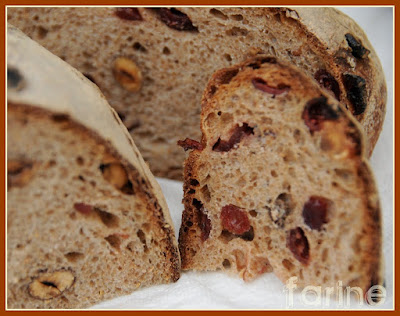
Hutzelbrot with dried cherries and cranberries

Besides the delightful taste of this bread, what I love about this Peter Reinhard recipe (from his book Whole Grain Breads: New Techniques, Extraordinary Flavor) is that it uses a mash and that the mash can be made in part with "old bread". To me there is already something deeply satisfying about pre-soaking whole grain flour and having the enzymes start working hours and hours before you even begin to mix your dough but when you can feed them your stale bread too, wow, it's just too good to pass up!
Reinhart uses (or suggests using, it's hard to figure out which) a mix of dried fruit for this bread, such as citron, apricots, figs, plums, cherries, cranberries, golden raisins). Even though I had pretty much everything on hand but the citron, I decided to focus the flavors a little more and go for the sweet dried cherries my friend Kim had brought from Wisconsin (each one like a burst of summer in the mouth, thank you, Kim!), paired with slightly tarter dried cranberries from Washington State. I also decided to soak the old bread in apple juice since I had some I needed to use up and it would nicely boost the fruit taste. The bread turned out crusty and surprisingly light.
It takes two days to make which is perfectly fine with me since most of the time the ingredients toil away all by themselves....


Ingredients (slightly adapted): makes 2 batards


For the soaked bread (altus)
  • 1/2 inch-bread cubes with crust left on soaked in hot organic apple juice or water and left at room temperature for at least 4 hours and preferably overnight. Use just enough liquid to saturate and soften the bread. Reinhart advises using rye bread but he says whole wheat is fine too. Squeeze out excess liquid before adding to the mash (I didn't weigh anything to start with, just used up all my stale bread and made a big bowl of actus. When required by the recipe, I took out the 170 g needed for the mash, weighed the rest, put it in a ziploc bag, labeled it and stored it in the freezer for next time)
For the mash
  • 300 g water
  • 64 g coarse whole wheat (I used flour from Cedar Isle Farm in Agassiz, British Columbia, which my friend Meeghen kindly brought me)
  • 64 g 75% sifted rye flour (I used flour from True Grain Bread on Vancouver Island, British Columbia, which Meeghen also brought me. Thank you, Meeghen, for giving me the opportunity to bake with these gorgeous flours!)
  • 1 g diastactic malt powder
  • 170 g altus
For the starter
  • 71 g whole wheat or rye starter
  • 213 g whole rye flour
  • 170 g water at room temperature (70°F/21°C)
For the dough
  • all of the starter (454 g)
  • all of the mash (397 g)
  • 99 g white whole wheat flour + 200 g (which I had to add because my dough was way too wet, possibly because I had pre-soaked the fruit which Reinhart doesn't say to do)
  • 99 g whole rye flour
  • 100 g sweet dried cherries (briefly pre-soaked, then drained)
  • 70 g dried cranberries (briefly pre-soaked, then drained)
  • 14 g salt (I didn't add to that amount even though I added more flour: I just tasted the dough and it seemed fine)
  • 7 g instant dry yeast
Method:

On Day 1
  1. Mix the mash ingredients (save for the altus) (using water heated to 165°F/74°C) making sure the flour is fully  hydrated and the end product resembles a thin pudding or gravy. Cover and keep warm (150°F/66°C) if possible for 3 hours or at least for 60 minutes. Reinhart suggests using the oven for that step (turning it repeatedly on and off if it doesn't have such a low setting) 
  2. After 3 hours, stir in the soaked bread and refrigerate until ready to use (you can also leave it overnight at room temperature) if you are planning to use it within the next 24 hours
  3. Mix all of the starter ingredients and knead with wet hands to form a ball of dough. Let it rest 5 minutes and knead again. The dough will be tacky. Allow it to double at room temperature (which can take up to 8 hours depending on the temperature). When fully developed, knead for a few seconds, cover tightly with plastic wrap and refrigerate overnight if necessary to coordinate timing with the mash. Remove from the refrigerator about 2 hours before mixing the final dough
On Day 2
  1. Using a metal scraper, chop the starter into 12 smaller pieces, sprinkling some extra flour over them to prevent them from sticking to each other
  2. If mixing by hand (which I did), combine starter and mash in a large bowl with the whole wheat and rye flour, cherries, cranberries, salt and yeast. Mix for about 2 minutes until all the ingredients are evenly integrated and distributed into the dough. The dough should be soft and slightly sticky. If not, add water or flour if needed (that's where I had to add the extra 200 g of white whole wheat flour as the dough was definitely not going to take shape otherwise)
  3. When dough feels soft and only slightly sticky, form it into a ball and let it rest for 5 minutes while you oil a container
  4. Knead it briefly again for one minute and make any final adjustments to water or flour. It should be malleable and tacky but no longer sticky
  5. Form into a ball again and place in prepared container, rolling to coat with oil
  6. Cover loosely and let rise at room temperature for about one hour or until it is at least 1 1/2 times its original size
  7. Transfer to a lightly floured surface and shape into two batards. Place the batards on a sheet pan lined with semolina-dusted parchment paper. Cover loosely with plastic wrap or a cloth towel and let rise at room temperature for 45 to 60 minutes, until 1 1/2 times their original size
  8. While the batards are proofing, preheat the oven to 425°F/218°C. When ready to bake, dust them with flour and score the loaves as desired using a sharp knife or blade
  9. Place them in the oven (with steam), lower the oven temperature to 375°F/191°C and bake for 25 minutes
  10. Rotate the loaves 180 degrees and continue baking for another 20 to 35 minutes or until the loaves are well-browned and make a hollow sound when thumped on the bottom
  11. Cool on a rack and wait at leasts 12 hours before slicing open.
Enjoy!


The Hutzelbrot with dried cherries and cranberries go to Susan for this week's issue of Yeastspotting.

Thursday, September 16, 2010

Cranberry-Hazelnut Whole Wheat Crisps

I just discovered my true self and as sad as it is to admit it, the truth is that, deep down, I am just a copy cat! My friends Larry and Gerry from Tree-Top Baking make fantastic fruit and nut crisps. Since they live and work on Whidbey Island, too far away from us to make resupplying easy (which is too bad because they also make a sprouted wheat bread which is to die for, not to mention excellent buckwheat batons and many other great breads), no sooner was I done baking the Hazelnut-Cranberry Whole Wheat Bread that I decided to imitate them and make my own fruit and nut crisps. Larry's crisps (sorry, I didn't take a picture and they are long gone) are thinner because he machine-slices the bread. Having no such equipment at my disposal, I waited for the bread to be two days old (which was no mean feat as it meant hiding it from the rest of the family) and used a well-sharpened knife. The crisps came out crunchy and fragrant with an intense hazelnut flavor. They were quite a treat. To make crisps, just slice a loaf of bread as thin as possible and set the slices to bake in a 300° F/149° C oven. Bake 10 minutes then flip over and bake another 10 minutes (your oven may be hotter or cooler than the one I used and you might need to adjust temperature and baking time accordingly). After 20 minutes, I flipped the crisps a second time, gave them two more minutes and took them out. Then I set them on a rack to cool and watched them disappear. The Cranberry-Hazelnut Whole Crisps go to Susan's Wild Yeast for Yeastspotting.

Wednesday, September 15, 2010

Cranberry-Hazelnut Whole Wheat Bread

I don't know how advanced the season is in other parts of the country but here in the Pacific Northwest, fall is most certainly on its way. The leaves are starting to turn and the nights are wonderfully crisp (although to be honest, they are also sometimes extremely wet!).
This being North America, cranberries - which had been temporarily shunned for their summery cousins - are back in our thoughts, bringing with them a craving for other fall fruit and nuts. When I was a child, my brothers and Ì spent every Sunday at my grandparents' house in Normandy, playing hide-and-see in the old barn where my grandfather used to raise ducks, feeding wheat berries to the chickens, petting the bunnies which (sadly but unbeknownst to us at that time) would later turn into delicious "civets" (fragrant rabbit stews which my grandmother would serve with buckwheat crepes) and, in the fall, filling our pockets with hazelnuts. Since no cranberries were to be had in France when I was growing up, I pretty much discovered them when I moved to this country and never thought of pairing them with hazelnuts until I visited Boulangerie La Rémy in Quebec last June. Even though visions of cranberries and hazelnuts have been episodically dancing in my head ever since, it took an email from Eric at the Fresh Loaf for me to actually accept the fact that summer is over and give it this bread a shot. I have almost none of my usual baking tools here at my kids' house, no books, no baskets (I used towel-lined colanders) not even a little strainer to dust the loaves with flour (which explains their rather floury look as I ended up using too much flour and having to wipe it off). But I have a 2007 issue of The Baking Sheet newsletter which features whole grain recipes and I have levain, thanks to my friends Gerry and Larry from Tree-Top Baking (a small bakery located on Whidbey Island which makes superior bread and delicious pastries). Again thanks to Gerry and Larry, I also have a blend of freshly milled whole grain flours in my usual proportion of 45% wheat, 45% spelt and 10% rye to feed my adopted levain. There are a few great natural food markets around here where I can pretty much find in bulk whatever grain or flour I want. But I opted for wheat, figuring that spelt's delicate flavor would be masked by the robust taste of the toasted hazelnuts and that rye and hazelnuts would fight for dominance instead of complementing each other.Since I really like to use whole grains whenever possible, I went for a 65% whole wheat dough. The resulting bread is very flavorful and, hopefully, quite nutritious. We all loved it. We actually packed some to take with us on a hike and found it to be the perfect accompaniment to a hard cheese at the end of a long trail in the deep forest. We munched on it while sitting on a fallen tree trunk and watching the sun play on the pebbles at the bottom of a little lake. Pure bliss!
(The following recipe is loosely based on the Walnut Currant Bread featured in The Baking Sheet, Vol. XVIII, no. 1, Winter 2007) Ingredients For the levain 114 g whole wheat flour 114 g water, at cool temperature 30 g firm levain (hydration: 65%) (I used whole-grain levain as explained above but if all you have is liquid levain, you can use it instead. Just adjust the water amount accordingly) For the final dough all of the levain 340 g whole wheat flour 241 g unbleached all-purpose flour 455 g water, at cool temperature 14 g salt 125 g dried cranberries (mine were slightly sweetened) 100 g hazelnuts (roasted in the oven and peeled by rubbing them together in a kitchen towel), cooled
Method (this bread is made over two days) The night before baking day Combine flour, water and levain, mix well, cover and leave to ferment overnight (or for up to 12 hours) On baking day
  1. Combine all of the levain with the remaining flours and the water and mix (since I don't have a mixer here at my kids' house, I mixed by hand) until the flours are thoroughly hydrated
  2. Cover the bowl and let rest for 20 minutes (autolyse)
  3. Add the salt and mix briefly or until the dough is smooth and cohesive (I used the stretch and fold method of hand mixing)
  4. Cover the bowl and let rest for 30 minutes
  5. Turn the dough out onto a well-floured surface and, wetting or flouring your hands (depending on the dough consistency), lightly pat it into a rectangle
  6. Sprinkle the cranberries over it and using a metal bench knife, fold it like a business letter over the cranberries
  7. Pat the dough out into a rectangle again, sealing in the cranberries and sprinkle with the roasted hazelnuts
  8. Using a metal bench knife, fold the dough again as a business letter but this time in the opposite direction to seal the hazelnuts in
  9. Put the dough back in the bowl and let it rest, covered for another 30 minutes
  10. After 30 minutes, take the dough out and give it another business letter fold on a well-floured surface
  11. Brush the extra flour off and return to the bowl and repeat the rising and folding twice more
  12. After 4 folds and 2 ½ hours of rising time, heavily flour two bannetons or colanders lined with linen towels
  13. Turn the dough from the bowl onto a lightly floured surface and divide in two (since I had different size colanders, I divided the dough roughly in two thirds and one third)
  14. Pre-shape into rounds, let rest covered 10 minutes and shape into balls
  15. Be careful not to tighten the balls too much or the nuts and berries will tear the surface of the skin of the dough
  16. Turn the loaves upside down into the prepared bannetons or colanders, cover them well and let them rise for 2 to 2 ½ hour
  17. About half-an-hour before the loaves are ready to bake, preheat the oven to 450° F/232° C with a baking stone in it (having no baking stone here, I preheated the oven with a thick metal baking sheet on the middle shelf and a metal pan on the bottom)
  18. Flip the loaves out of the bannetons onto a piece of parchment paper, gently brush off the excess flour (preferably with a pastry brush if available), slash in desired pattern and use a peel (I used another baking sheet) to load them into the oven
  19. Pour a cup of cold water in the prepared metal pan and close the oven door
  20. After 20 minutes, turn the loaves around and continue baking for another 20 minutes, removing the metal pan if there is any leftover water
  21. After 40 minutes' total baking time, turn off the oven and leaving the oven door slightly ajar (I used a wooden spoon to prevent it from closing completely), let the loaves dry out for about 10 minutes
  22. Take them out of the oven and set them on a rack to cool.
The Cranberry-Hazelnut Whole Wheat Bread goes to Susan's Wild Yeast for Yeastspotting.
 

Blog Designed by: Deanna @ Design Chicky