


Related post: Pear-Chestnut Confit
I don't often write about non-bread magic but I must share with you this visit to Solange Couve, jam-maker extraordinaire who lives with her husband Stéphane (whom we didn't get to meet as he was away visiting his mother), her dog Victor and her two cats, Lulu and Lily, in a remote corner of the Ardèche department in south-central France. From the highway it takes about 45 minutes and hundreds of steep curves on very narrow roads (we were glad to be traveling on a holiday when traffic was sparse) to reach the farm.

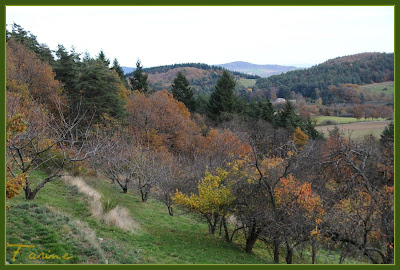
New vistas opened up with each turn in the road and if it had been possible to stop more often (alas, opportunities to just get off the road and admire the landscape were few and far between), I could have taken dozens of pictures, all different. It's easy to understand why so many of my French friends rave about vacationing in the Ardèche backcountry.


Like Emerald City in the Wizard of Oz, the farm is literally located at the end of the road.


The farmhouse has remained pretty much as it was when Solange and her husband decided to make it their permanent home 27 years ago. The sink has remained the same, the doors and walls were repainted in their original colors and the volumes were not altered.

Solange and Stéphane happened upon the farm one day while traveling in the area and fell in love with it at first sight. It then belonged to two elderly sisters who, as it turned out, were only too glad to sell and move away. The surrounding land had been left idle for 20 years although some of it was being farmed by neighbors. The couple led a busy life in Paris where Stéphane was a dentist with a thriving practice and Solange, who was a real estate agent, spent her week commuting from the capital to central France and to Corsica. In other words, they mostly saw their new house as a destination point for downtime.

After a few years however the pull of the farm became too strong to resist. Stéphane sold his practice and bought a new one in the Rhone valley, about 45 minutes away. As for Solange, she decided to forego real estate and to become a farmer. Now for that dream to become reality, two things needed to happen: the land had to be cleared up (a process which involved an enormous amount of manual labor) and Solange needed to acquire notions of agriculture. Not a woman to be easily deterred, she enrolled in an agricultural studies program in Valence and spent a year learning everything there was to know about trees: how to plant and prune them, how to take care of them, etc. When that was done, she spent another year learning about food-processing to find out all she could about sugar chemistry. An overkill, she soon realized, for someone whose only aspiration was to learn how to make jam properly. But Solange is nothing if not thorough and she forged ahead.
Meanwhile the land had been cleared and planted with close to 4 acres of fruit-trees. Since the Ardèche is raspberry-heaven, Solange also planted 2.5 acres of raspberry bushes as well as red and black currant bushes. For the first 10 years, she produced on average 6 tons of raspberries a year and sold them fresh to the local cooperative. Then the raspberry bushes were hit by some illness and had to be ripped out. She decided to diversify.

Using no other ingredients than fruit (pears, apricots, peaches, quinces, berries, etc.) from her land and sugar, she started producing more than 5 tons of jam a year which she sold mostly to luxury hotels and restaurants and to high-end grocery stores and bakeries as well as to fruit and vegetable markets which offer a small artisanal product section.

Since she had kept the chestnut-trees (the Ardèche is famous for its chestnuts) which were on the property when they bought it, she embarked on a trial-and-error learning process which taught her how to turn her chestnuts into delicious marrons glacés (candied chestnuts), crème de marrons (chestnut spread) and purée de marrons (chestnut purée). She also learned how to make pear-chestnut confit, an exquisite concoction which can be served with a brioche as a light dessert at the end of a holiday meal or poured over fromage blanc (soft curd cheese). As soon as she mentioned it over the phone, I knew I wanted to learn how to make it and report on it on the blog (after all, it could tempt you to make a brioche to go with it!).

Today Solange is semi-retired. She has kept her workshop (located about 2 miles away from the farm) but she only works for a few luxury hotels and restaurants on the Côte d'Azur and in the Alps as well as for family and friends. She still makes marrons glacés and other chestnut delicacies, including the confit, but she no longer sells them (too much work). I wish I could describe in details the lunch and dinner ardéchois she prepared for us and the extraordinary breakfast that awaited us in the morning featuring grape juice from her own grapes, no less (they grow on the vine that shades the big table just outside the kitchen door), but it would be off subject. Suffice it to say that Solange loves to cook and that her imagination is bottomless when it comes to extracting as much flavor as possible from the fruit and vegetables she grows on her land. We were awed!


