


So you won't be surprised to read that I felt a bit nervous reporting on Professor Andrew Ross's lecture on gluten at the Grain Gathering 2015. I listened to his talk. I dutifully looked at the slides. I took notes.
But I wasn't comfortable with what I had jotted down. Not comfortable enough to make a blog post out of it. So I wrote to Andrew Ross, a cereal scientist at Oregon State University in Corvallis, Oregon (as well as a passionate and accomplished baker) and asked him if he would agree to share his talking points. He very kindly forwarded me the text of his whole talk. All direct quotations from his text are in green and between quotation marks. The rest comes from my notes (I am keeping my fingers crossed!).
Gluten has unique functional properties: it traps gas. That's why when bread is baked, you don't get a solid brick. How come?
- "Gluten is a group of proteins found in the endosperm (floury interior part) of wheat grains. Gluten-like proteins are also found in barely and rye." Wheat includes all types: common hard- grained bread wheats, common soft-grained wheats, einkorn, emmer, spelt, and khorasan (kamut™) among others.
- "The gluten-forming proteins of wheat are made up of two types: gliadins and glutenins."
- "After the addition of water and mechanical energy to wheat flour to form a dough these proteins combine to form functional gluten. Functional gluten is what gives wheat flour doughs their unique gas holding and viscoelastic properties that lead to leavened breads. Gliadins contribute the flow and glutenins the elastic characteristic of wheat-flour dough."
- Gliadin contains amino-acid sequences that are particularly toxic to celiacs.
- Celiac disease (an autoimmune disease): definite
- Specific wheat allergies: definite
- Non-celiac wheat sensitivity: fairly certain
- Non-celiac gluten sensitivity (NCGS): under challenge
"Although a fairly large segment of the population appears to be avoiding, reducing, or wanting to avoid gluten, even the most ardent science-based advocates of the reality of non-celiac gluten sensitivity estimate its prevalence at 0.63 to 6% of the population."
"Questions arise as to why there has been a documented increase in celiac disease in the last say 50 years, still estimated at about 1% of the population. Some blame has been laid at perceived changes in wheat grain composition independent of changes in other factors in the environment of the western world in the same time period."
Are we eating more gluten?
Has gluten concentration increased?
I look at my notes. They read "Nonsense" underlined three times!
Are we eating more gluten?
- Not really. "US wheat consumption per head was maximum in the years around 1870 to 1900 at around 225 lbs per person per year."
Has gluten concentration increased?
I look at my notes. They read "Nonsense" underlined three times!
- In this 2012 article, Sapone et al write: "“One possible explanation is that the selection of wheat varieties with higher gluten content has been a continuous process during the last 10,000 years, with changes dictated more by technological rather than nutritional reasons.” According to Andrew Ross, "this piece of speculation" can be challenged by data showing that it is simply not true: Research does not "support the likelihood that wheat breeding has increased the protein content (proportional to gluten content) of wheat in the United States." (Donald Kansarda, Can an Increase in Celiac Disease Be Attributed to an Increase in the Gluten Content of Wheat as a Consequence of Wheat Breeding?, J Agric Food Chem. 2013 Feb 13; 61(6): 1155–1159.) For more info, read Kansarda's whole article.
- Also, ancient hulled wheats often had a high protein content.
- It is often asserted that, as a species, we haven't had a chance to adapt to wheat because it has only be introduced in the human diet 10,000 years ago.
- But then, what to make of milk? "Caucasian humans have adapted to life-long dairy consumption within about the last 7500 years."
For more info, see Archaeology: The milk revolution, by Andrew Currie - Also, cereal grains have been part of our diet for an estimated 23,000 years (wild wheat and barley), and 105,000 years (sorghum).
For more info, read Six Thousand Years of Bread: Its Holy and Unholy History by H.E. Jacob.
So how did we get to Wheat Belly?
- "In Wheat Belly, Davis states “[wheat is] an 18-inch tall plant created by genetic research in the '60s and '70s, this thing has many new features nobody told you about, such as there's a new protein in this thing called gliadin. It's not gluten”. This statement is so categorically wrong that it does not dignify a response. However, it has swayed many people."
- "Others have insisted that the “problems with wheat” stem from the introduction of the short stature wheats in the 1960s." It is true that wheat breeders have thought more about functionality than nutrition for the last 30 years. But coincidence isn't causation as you can easily verify yourself if you google "spurious correlations." Do it, it is hilarious! I just did and discovered for instance that "divorce rate in Florida correlates with per capita consumption of 1% and skim milk (US)". Ha!
- Short stature wheats are not new. They have been around for years in Asia and Australia. And kernel composition and straw height are not associated with each other.
- That question is still open to debate. Some researchers think that wheat sensitivity is caused by wheat components other than gluten. Others insist it is gluten. But even the latter say that added together celiac disease, true wheat allergies, and non-celiac wheat (or gluten) affect about 10% of the general population. "That leaves 90% of us who might benefit greatly from the consumption of well-fermented mostly whole-wheat products."
- Non-celiac wheat sensitivity is a more appropriate label than gluten sensitivity.
- Einkorn and emmer have a much lower reactivity to celiac disease.
- New varieties could be developed with the quality traits we desire but with a lower potential to trigger celiac disease in susceptible people.
- Strongly recommended reading (open-source download): Kucek, L. K., Veenstra, L. D., Amnuaycheewa, P., & Sorrells, M. E. (2015). A Grounded Guide to Gluten: How Modern Genotypes and Processing Impact Wheat Sensitivity. Comprehensive Reviews in Food Science and Food Safety, 14(3), 285-302.
Kucek (in above article) proposes that long fermentations are beneficial. "However," Andrew Ross says, "I am personally skeptical that the advent of fast-fermented machine-made bread is the culprit leading to the increase in celiac disease. Other factors may be at play. Allergies and many auto-immune diseases not all related to wheat also appear to be increasing. The so-called 'hygiene hypothesis' suggests other factors are primary in the relative increase in auto-immune disorders in the western world."
- Fructans -which are present in wheat- are part of the fiber composition. For most of us, increased fiber is a good thing, but not for people with low tolerance to fermentation in their gut. Why do people with NCGS report feeling better when eating long-fermented bread?
- Lack of exercise
- Changes in infant feeding practices
- Processing techniques
- Hygiene (too much of it)
- Light pollution/sleep deprivation
- Nitrogen content of soil (best driver of protein content in wheat)
My most heartfelt thanks to Professor Ross for sharing his talking points. I have only included a few of his sources but I will gladly email the others to whomever requests them. Most of them are very technical and not necessarily available outside research libraries.

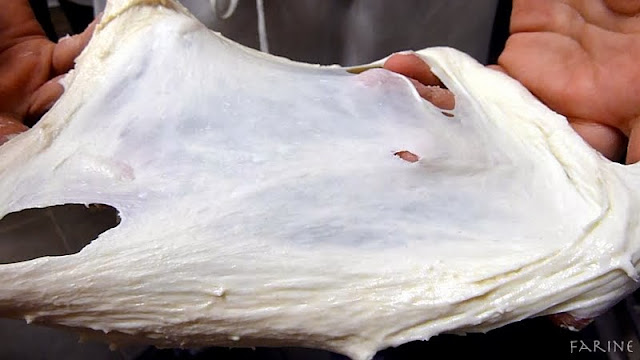
A picture of gluten strands kindly contributed by my facebook friend Yohan Ferranta talented baker and baking consultant who lives and works in Spain.
This is actually a picture of his levain. Thank you, Yohan!


