Home About Recipes Artisans Blog Notes Resources
Showing posts with label Kamut. Show all posts

Monday, August 6, 2012

100% Whole Grain Spelt & Kamut Pavés

Maybe because it is summer and I bake constantly to feed my family, I find I have become a minimalist when it comes to bread: I like doughs that require minimum intervention on my part (an autolyse and a few folds and they are on their way) and yield loaves that bring smiles to everyone's face while providing good nutrition (the more whole grains the better). These pavés (pavé is French for cobblestone) satisfy on all counts.
The inspiration came from a facebook post by French SHB Thierry Delabre who created a half-kamut and half-spelt bread he called a "fanette". Thierry used a firm levain, hydrated the dough at 75% and retarded it for 16 hours at 43° F/6° C. The result (which I wish I could show you but the pictures are on facebook, not on the web) was a beautifully golden rustic loaf.
I had freshly stoneground whole kamut flour which I had bought across the river in Ontario the day before and I had a bag of Quebec spelt grains I could mill but I was all out of mature firm levain and I couldn't go beyond eight hours' total fermentation time as we needed bread for dinner: there have been six of us here at camp in upstate New York for the past ten days and I don't believe I have ever seen such bread eaters as these three little kids - one seven-year old and five-year old twins. I bake and bake and barely keep up. Whenever they are hungry, bread is the first thing they ask for, quite often with no adornment, not even butter, like true bread purists! It keeps me pretty busy but I love knowing that the taste of bread is being passed down to their generation.
Plus they see me mix dough everyday, usually when they are having breakfast. Maybe one day when they are all grown-up and crave honest bread, they'll remember that all it takes is a big bowl and two hands and they'll want to learn how to make their own. One can only hope, right?
I didn't have a working firm levain but I had plenty of the liquid variety and it smelled so good I had to bake with it or I would be tempted to eat it with a spoon (just kidding!). To come back to the kids (and I promise I won't mention them again in this post), another thing that goes straight to my baker's heart is that they all three love the fragrance of levain and breathe it in with relish whenever they have a chance (they say it smells like bread!). Ok, so enough with the grand-kids and on to the dough.
I decided to borrow Thierry's idea and go for a 100% whole-grain loaf that would be 50% spelt and 50% kamut but I would use liquid levain and I would up the hydration a bit. Like him, I would do one post-fermentation fold in lieu of pre-shaping and cut the folded dough into rectangles without further shaping (hence the pavé shape). Unlike Thierry - whose dough had a different consistency - I wouldn't score.
The bread came out seductively "moëlleux" (a French word I always have trouble translating: it means "mellow", "tender", "cushy" and "smooth" at the same time -it can also mean "sweet" when applied to wine- and I don't think there is an exact equivalent in English) and yet it is the word that comes irresistibly to my mind when I think about kamut. Spelt tends to be a bit drier in the mouth but it is sweet and fragrant in its own right and combined, the two grains conjure up the scent and taste of summer itself, sun-baked fields and all. These pavés may not be much to look at: I lack couches here at camp, so they spread a bit as they proofed, especially because both kamut and spelt are low in gluten, but they do pack a wallop in the mouth.
Ingredients: (all organic)
  • 493 g whole kamut flour
  • 493 g freshly-milled whole spelt flour
  • 749 g water
  • 295 g mature wheat levain at 100% hydration
  • 18 g salt
Method: (hand-mixed)
  1. Mix both flours with all the water until no dry flour remains and let rest, covered, 20 to 40 minutes
  2. Add the levain and mix until incorporated
  3. Add the salt
  4. Cover the dough and let it rest, doing as many folds as necessary to obtain medium soft consistency
  5. When the dough is ready (it took about seven hours at my house with folds every thirty minutes for the first two hours but then the outside temperature was otherworldly hot and we had the A/C on all day), transfer it out of the bowl on a floured surface and fold it once over itself length-wise forming a long rectangle (no overlapping)
  6. Pre-heat the oven to 470°
  7. Using a wet dough scraper, cut the dough into four even pieces
  8. Transfer the pieces to baking sheets lined with parchment paper (heavily dusted with semolina) (as mentioned before, I have no couches here, hence the paper, but if you can, it would be better to proof the pavés upside down on heavily floured couches, turning them right side up prior to baking)
  9. Cover and let rest for 30 to 45 minutes
  10. Bake with steam in pre-heated oven (470°F/243°C for 10 minutes then lower the oven temperature to 450°F/232°C and continue baking for another 20 to 25 minutes, turning the loaves half-way through to ensure even baking (again these temperatures are given solely as an indication. Here at camp, the oven is small, very old and rather weak and I have to crank it up to the max. I actually set it on 500°F+  for the initial 10 minutes and on 470°F for the remaining 20 minutes or so but, from past experience with my regular home oven, I would say 470° F and 450°F should do the trick. If your oven is very efficient however, these temperatures might need to be adjusted down)
  11. Cool on a rack
  12. Enjoy!

The Whole Spelt & Kamut Pavés go to Susan from Wild Yeast for this week's issue of Yeastspotting.

Monday, June 22, 2009

Kamut Miche


Yearning after the gorgeous breads that Safa Hemzé made at SFBI this winter using specialty flour starters, I decided to make a spelt miche. When I started rummaging in my flour chest however, I discovered we were all out of spelt but that we had a cache of whole kamut flour I had completely forgotten about. So I switched grains.
Kamut is actually a brand. The common name of the cereal is khorasan. But good luck with finding khorasan in the stores!
As the story goes, it was found in an Egyptian tomb by an American who shipped a few grains home to his father. The father sowed the grains and trademarked the name. Originally from Mesopotamia, kamut as we know it is organically grown in the United States. It is richer in protein and some minerals, especially selenium, than wheat but poorer in gluten. It is sometimes tolerated by people who can't have wheat, not however by people who have coeliac disease (according to Wikipedia).
I took a portion of my white starter (100% hydration), fed it twice with kamut and decided it was ready although it looked definitely less perky than when fed with wheat. But ready it was because even though I chose a long fermentation over the addition of instant yeast, it gave me a very satisfactory oven spring.
Oven spring isn't all there is to like about this bread, however. Safa is right, when you switch flours in the preferments, you do get amazing flavors. This bread has a complex and delicate taste. It is delicious just eaten on its own, especially because the crumb turned out silky and, while not wet, still not dry either, just what you want in a piece of bread when you don't necessarily intend to put butter or anything else on top. If I was given one word only to describe this crumb, I would say that it is voluptuous...
The dough mixed easily but wouldn't accept all of the 65% of water I had planned for it. It just wouldn't. So I didn't insist. I let it reach the desired consistency (low-medium gluten development), then ever so gently I added in most of the remaining water. I did it very slowly, so as not to drown the gluten and it was fun to see it gasp and sink and then swim back to the surface and ask for more. At one point though it clearly had enough and that was it...
I find doughs have a mind of their own and - most of the time - it's fun to look for it and discover it and then work with it.
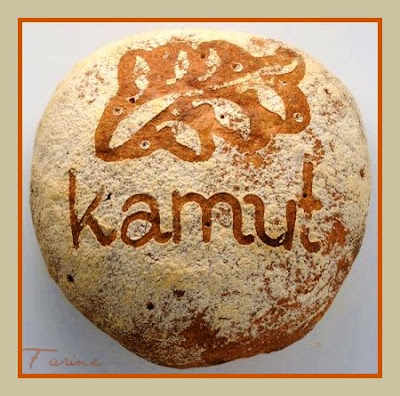
I had just read Joe Ortiz's chapter on stencils in The Village Baker and I decided to try his technique of piercing the surface of the dough in 8 or 10 differents points before stenciling, so that you don't need to score and still the bread won't implode. The bread definitely didn't implode, so it worked, but I don't care very much for the look of these holes. They make it seem as if I'd tried to make Swiss cheese, not bread. I didn't use an icepick as Ortiz recommends but a thin wooden skewer, the kind that's used for chicken satay. But an ice pick probably makes even larger holes, so I don't think that was the problem...
I also discovered that although it's fun to write with flour, a miche doesn't give a baker a lot of writing space. Kamut is fine, so would wheat and spelt be and rye would be even better, but forget about buckwheat or amaranth! So if miche-writing is your calling, be sure to pick your grain carefully...
Ingredients:

  • 476 g unbleached all-purpose flour
  • 127 g white whole wheat flour
  • 127 g kamut starter
  • 32 g whole grain kamut flour
  • 412 g water (I had 19 g left at the end of the mixing)
  • 14 g salt
  • 13 g olive oil
Method:
  1. Put the flours, the starter, the oil and 80% of the water in the bowl of the mixer
  2. Mix at low speed until incorporated
  3. Cover the bowl with a towel and let rest 20 to 30 minutes (autolyse)
  4. Add the salt and mix until the dough reaches low-medium consistency (when you wet your hands and pinch a piece of it, as you stretch and turn, you should start seeing a translucid membrane with some opaque spots)
  5. Start adding the remaining water very slowly until the dough can't take anymore
  6. Set the dough to ferment in a large covered lightly oiled bowl or dough bucket
  7. Give the dough a fold 30 minutes later, repeat after 30 minutes if the dough is still too slack
  8. Let the dough finish rising (it should have almost doubled. In my relatively cool kitchen 0 68F/20C, it took 7 hours altogether)
  9. Pre-shape the dough in a ball and let it rest 20 minutes, covered
  10. Shape it into a tight ball and let it proof for about 40 minutes on a flour-dusted parchment paper sheet set on a baking sheet
  11. Preheat the oven to 470 F/243 C with a baking stone in the middle and an empty shallow metal pan on a different oven shelf
  12. Pierce the loaf to a depth of about 1 inch (4 cm) in 8 or 10 different spots and stencil it if desired (one can also just dust the miche with flour and score it)
  13. Pour a cup of water in the prepared metal pan inside the oven (taking care to protect your hands and face) and slide the miche onto the baking stone
  14. Spray the oven walls with water and quickly close the oven door
  15. Lower the oven temperature to 450 F/232 C and bake for 30 to 40 minutes. The inside temperature of the loaf should be over 205 F/96 C.


The Kamut Miche goes to Susan, from Wild Yeast, for Yeastpotting.


Blog Designed by: Deanna @ Design Chicky