Home About Recipes Artisans Blog Notes Resources
Showing posts with label Baguettes. Show all posts

Friday, November 21, 2014

Meet the Baker: Frédéric Pichard

I am filing this post under the Meet the Baker label but in fact the two hours of this time Frédéric Pichard so generously gave me on a recent Saturday morning were less about him than about his all-consuming passion, le pain français. Pain français means "French bread" of course but I won't use the translation in this post because Monsieur Pichard would have a fit if he could see what comes up when one googles "French bread," definitely not the kind of bread he is devoting his professional life to. He has no website and zero interest in the Internet, so hopefully he won't see these pictures but, out of respect, I'll stick to the original French. I first met Frédéric Pichard in a chapter of Sam Fromartz' excellent book, In Search of the Perfect Loaf, a Home Baker's Odyssey. Despite the fact that Pichard had won best croissant in Paris in 2011 and that his baguette had placed in the top ten in the 2009 Grand Prix de la Baguette, I hadn't really paid much attention before but when I read what Sam had to say about his methods, I knew I had to go see him. And even though I am not sure Monsieur Pichard knows what a blog is,  he was most welcoming when I called. And at the appointed time, we sat under a tree at a long table in the quiet courtyard behind the boulangerie. Madame Pichard came to say hello and brought me coffee and a croissant.
 I thought of Sam who described Pichard's baguette as almost floating in his hand as he held it. Well, that croissant was so crisp and light it practically levitated. Definitely worth crossing a continent AND an ocean but hard to eat elegantly: as it dwindled, it kept showering my open notebook with golden flakes which I tried to brush away while still writing a mile a minute... Not an easy feat. Fortunately Monsieur Pichard paused long enough to let me catch up.

Croissant dough (made with milk levain)
As you will see if you read on, what Frédéric Pichard gave me that morning was a treatise on pain français, complete with practical information and historical references, and because he was so intensely involved in his subject, listening to him was an unexpectedly moving experience. Monsieur Pichard knows full well that he is un oiseau rare (literally a rare bird) among French bakers. When I told him that he reminded me of Don Quixote, he laughed and he shrugged. Like all of us, he can only do his best, right?
If an eighteenth-century French baker time-traveled to Maison Pichard, 88 rue Cambronne in the fifteenth arrondissement of Paris, he or she (were there women bakers then?) would feel at home almost immediately. The technology and equipment have evolved but the process has remained almost identical. They would find the flour and its sometimes erratic behavior eerily familiar as well. They used farines-mères, a flour whose only ingredient was wheat. Frédéric Pichard does too: no additive is ever allowed into his flour, not even malt. The grain is grown and milled to his specifications in his native Beauce, a region so fertile that, from time immemorial, its vast plains have been considered France's breadbasket. One of his grandfathers was a farmer and he used to say: "France is divided in two parts: one half is to the north of the Loire River, the other half to the south. Pain français comes from the northern part of France where wheat grows best." Today Mr. Pichard makes his baguettes with the very same high-protein wheat varieties that this grandfather used to grow: Capelle, Capitole, Hardi. Why high-protein? To prevent gluten degradation during fermentation.
Pichard bakes his baguettes in a wood-fired oven because falling heat makes for better development. The bread gets a bit chewier and therefore tastier. The cost of wood isn't an issue: "Because I use my own flour and don't pay a premium to a miller for putting in additives and test-developing recipes, I can afford wood and still sell my baguette at a very competitive price."

What follows is a synopsis of what Frédéric Pichard told me, based on a translation of my notes.

What is pain français?
  • "Le pain, ce n'est que de la fermentation;" (Bread is nothing but fermentation)
  • Pain français is bread made of pure T55 flour sublimated through the fermentation process (according to this article, the ash content for T55 flour is 0.50-0.62 and the extraction rate 75-78). The flour must contain no additives of any  kind: a baker who uses additives is alienating his or her profession. To use a wine-making metaphor,  it is like adding raspberries to Romanée-Conti
  • Pain français must taste lactic and its flavors be subtile; using a higher extraction flour would make for a stronger taste and the resulting bread wouldn't be pain français; 
  • There is no prescribed recipe for pain français; the baker must adjust to the flour: wheat has its vintages as does wine. Moreover, "les blés bougent à chaque écrasement" (wheat changes with each milling);
  • Pain français is all about the baker's savoir-faire (know-how);
  • When properly made, the baguette is the ultimate pain français.
In the eighteenth century, bakers of pain français:
  • Always worked en masses importantes (in large batches). The size of the batch was proportional to the oven capacity;
  • Used as much water as they possibly could and mixed until the dough started to look homogenous and the gluten network to develop; didn't work from a recipe (there was none);
  • Let the dough ferment for a while (sometimes up to ten hours) then added fresh flour and water to prevent pourriture (decay), i.e. the formation of undesirable acetic bacteria. These additions were called rafraîchis. Their object was to "launder out" the unwanted bacteria which routinely appeared because the bakers used wooden troughs (where germs tended to proliferate) and worked in labs that were not immaculate;
  • Let the dough ferment again and added the salt at the end of the mixing; then did the last rafraîchi, called tous points;
  • Worked in the room where the oven was, which means that there could be tremendous variations in ambient temperature. Typically the oven wasn't lit yet when the mixing began. The lab went from really cold at the beginning to really hot towards the end of the process. Such variations in temperature were detrimental to the yeast micro-organisms.
To make pain français today, Frédéric Pichard: 
  • Applies the CELFEL (Culture Endogène Longue/Fermentation Exogène Lente) method that he has developed over the  years (lengthy endogenous culture/slow exogenous fermentation);
  • Mixes flour, salt and water in stainless steel cuves (see picture below: the word is normally used for wine and means "vats") which are scrubbed and bleached between each batch and allows the mixture to rest for as long as needed to get the endogenous fermentation he is looking for. This fermentation differs from autolyse (whose function is to relax the gluten.) Here there is no prescribed duration: the process can take twenty hours, it can take more than thirty. The key is to add as much water as the flour can take. The more water, the more active the fermentation; no recipe can help the baker determine how much water to use. If a baker applying the CELFEL method underestimates the amount of water that the flour can absorb, then the baking goes south: there is less fermentation which means the development won't be optimal and the bouquet aromatique will be less complex;

Fermented baguette dough ready for the addition of yeast and for mixing
  • Adds a minute amount of fresh yeast (0.2 to 0.4% of flour weight, sometimes even less than 0.1%) at the time of the final mixing "pour imprimer au pain une poussée gazeuse" (to facilitate a gaseous thrust) which, combined with the bulles sauvages or wild bubbles created during the long endogenous fermentation, will help give the crumb its honeycomb structure);
  • Mixes only as long as necessary to develop the dough;
  • Allows the dough to ferment again for four to seven hours after mixing; 
  • Doesn't proof his baguettes: once shaped, they are ready for the oven after one single long slash with a lame;
  • Uses a wood-fired oven in which he burns hornbeam wood (the young tree growing in his courtyard is a hornbeam which he planted to honor the wood that helps make his pain français);
  • Bakes his baguettes for 20 to 22 minutes or so;
  • Never uses his retarder for pain français, only for bulk viennoiserie and specialty doughs. 
A bit of history
  • Le pain français first appeared at the time of the First French EmpireTalleyrand, France's most important diplomat under several kings and one emperor, was a gastronome; his chef Antoine Carême made it his mission in life to refine French cuisine as a whole, bread-baking included. He had flour sifted so that only the white endosperm was retained. No longer able to rely on the strong taste of grain, French bakers learned to use fermentation to create flavorful and airy breads: they invented pain français;
  • Pain français became famous because it was the bread of the rich and powerful (lower classes ate miches which generated no interest). Almost every country in the world has a bread tradition, yet twenty years ago nobody talked about Italian breads or pita bread; multigrain loaves started appearing thirty-five years ago in Paris; Parisian bakers began using dried fruit in bread twenty years ago or so. These breads are tasty because they contain ingredients suitable for pastry. They are not to be confused with pain français.
Further remarks
  • One gram of flour contains thirty to forty yeast micro-organisms, one gram of baker's yeast contains one hundred billions. Most bakers use way too much baker's yeast with the result that no characteristic aroma is produced; that's why they use flour to which malt has been added;
  • The Meilleurs Ouvriers de France (MOF) bakers have considerably evolved over the years in terms of shaping and presentation. But bread must be judged based on both its esthetic and its organoleptic qualities and unfortunately only esthetics seem to matter today. The French no longer know how to taste their bread. If they did, they would know it isn't good. Aromas are what make bread interesting, the reason we get it day after day and never get tired. Combining aromas is an art, l'art du boulanger, the baker's art;
  • When the wheat varieties that Pichard uses were developed, there was no seed lobby, no studies. Only know-how. Money wasn't the only factor then: work ethics and honor were important values. Today two criteria enter into play when creating new seeds: resistance to disease and productivity. In the old days, organoleptic qualities were taken into account as well. Pain français was at his best from 1900 to 1960 because that's when wheat was at its best.
  • Nowadays, more often than not, pain français is an imposture. The fault lies with the millers who strive to normalize flour. In France, four milling companies produce 68% of the flour used by the bakers. They eliminate all possible variations, come up with a recipe and standardize the bread when there should be as many baguettes as there are bakers;
  • Learning how to make pain français takes ten years. Everything else (pastry, viennoiserie, specialty breads) can be learned in six months; 
  • The baguette is key to the survival of individual bakeries in France. In Germany where manufacturing plants are humongous, stores sell for more money a bread that costs less to make and bakeries are disappearing. The beauty of the baguette is that it must be eaten fresh, so that customers have to come in everyday. If all bakers made only miches, there would soon be no more bakeries in France;
  • Maison Pichard makes three to four thousand baguettes a day.

Brioche dough

Maison Pichard's laminated brioche
Before leaving, I asked Monsieur Pichard what recommendations he would have for a serious home baker who wanted to make good baguettes. He sighed. He knew I live in the United States where access to a local bakery is more problematic than in France and I could see he was trying to come up with an encouraging answer. After a minute, he said: "Use nothing but pure wheat flour, water and salt and rely on fermentation alone to develop aromas. That should give you a good wheat bread." He didn't say pain français.

Saturday, March 24, 2012

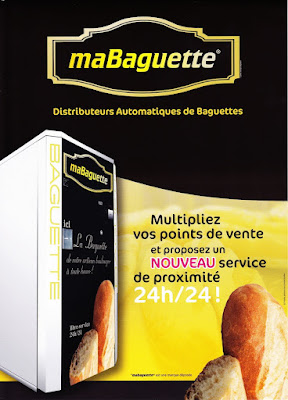
A slot machine for baguettes? Only in France!


The company's flyer as given to me at the show
When I was a child growing up in Paris, my grandparents moved from their native Southwestern France to Normandy to be closer to us. We used to go visit them every weekend and sometimes for small vacations as well. They grew all their own fruit and vegetables, raised poultry and rabbits, got milk and eggs from the farm next door, foraged in the nearby woods and meadows for wild greens and mushrooms and generally-speaking lived pretty much off the grid. One thing they didn't make though was bread.
They had grown up in households where breadbaking was a bimonthly chore and they probably felt that it was a huge improvement to be able to buy bread instead of making it themselves. An itinerant bread-delivery van circled the villages, it beeped outside the kitchen door, my grandma got out with her change purse, exchanged a few words with the driver (who might have been the baker doing his rounds but I never thought to ask, so I can't vouch for that) and went back inside with her bread. On the days the van driver was off, my grandpa got onto his Solex (motorized bike) and, into his early eighties, rode 2.5 miles to the nearest bakery. He came home with long fat yellow loaves fastened to the back of his Solex and since he wore a béret at all times (even indoors, except at night when he replaced it with a night cap), he must have looked like the poster Frenchman of bygone years we all have seen at some time or other.
I don't know if many bereted grandfathers still roam the roads of France on Solexes but while bread is still delivered door to door in some communities, I suspect that with the multiplication of grandes surfaces (large supermarkets selling everything under the sun) on the outskirts of most little cities, many families get their bread another way.
However there may still be a need for an alternative: elderly people with no means of getting around may live in remote villages with no bakeries and no bread deliveries; workers on different schedules may not want industrial bread and yet can't make it to the bakery before it closes for the day; gridlock and parking issues in busy downtowns may make it a hassle to actually get to the bakery; costs of doing the rounds may be too high for itinerant bakers, etc.
Whatever the reason, I saw at Europain an automatic baguette dispenser that stopped me dead in my tracks. Here is how it works: the artisan baker loads the machine with a batch of baguettes (62 is the maximum number) and the machine keeps them at room temperature. There is an optional alarm-system which alerts the baker when the distributor is empty and needs to be re-loaded. There is also a lockdown mechanism which prevents the sale of day-old baguettes. Sold at the same price as at the bakery, the baguettes are as good (or as mediocre) as the baker makes them.
The company, aptly called maBaguette, has sold and installed fifteen of these distributors in Western France since it started in July 2011 and it is looking to expand. Its main hurdle is to convince bakers that the machines shouldn't be installed right outside their bakeries where they can keep an eye on them but in remote places where bread isn't easy to come by. It emphasizes the fact that they are very low-maintenance and should be seen, not as stop-gap devices, but as additional points of sale which can be put inside shopping malls, offices, gas stations, railroad stations, even hospitals, and make it possible for the baker to reach a new customer base.
Whether or not the company will succeed is anybody's guess. Personally I know that I'd rather get my bread from a bakery where it is most likely fresher and where I can ask for "bien cuit" (nicely browned) but in a pinch, hey, why not? The baguettes thus distributed are probably better than their supermarket equivalents. As for the machines, they do make it easier for bakers to perform what some of them consider as their professional duty, i.e. facilitating acccess to artisan bread in their communities.

Wednesday, March 7, 2012

Award-winning baguettes in Montmartre

It was drizzly and cold as we climbed up the street from the métro station to the rue des Abbesses but we hardly noticed. As part of the bakery tours organized by the Bread Bakers Guild of America, we were on our way to Au Levain d'antan (6, rue des Abbesses), the bakery who won the best baguette in Paris award in 2011, and we were excited. The owner, Monsieur Barillon, was away in Japan but he and his wife had kindly agreed to let les boulangers américains visit the lab and talk to Jean-Luc, the head baker.
The baguette which wins the prestigious award becomes a staple at Palais de l'Élysée (the French equivalent of the White House) for a year. Eating the best bread in Paris everyday, now that's a presidential perk I truly envy! If I lived in France, it might even be enough to make me want to run for office... 
Since the baguette is presidential material, I thought its specs might be a secret d'État (a state secret) but no, Jean-Luc kindly agreed to answer our questions: the baguette is made with T65 flour (the only flour that can be used by law in baguettes Tradition, it contains no additive whatsoever) over a 6-hour period (from start to finish), using .8% of yeast and 74% water. It is autolysed for 45 minutes and mixed for 17 minutes on first speed. It ferments in the mixer for one hour with one fold at the 30-minute mark.
Another fold is done just before taking out of the mixer and divided into several bins. It ferments for another hour in the bins, then it is divided and shaped. Proofing time is an hour. The baguettes you see Jean-Luc dust with flour had been shaped an hour earlier. 
We had a taste before we left (Jean-Luc even gave us a few baguettes to take with us). The crust was delicate and crunchy at the same time and the crumb literally melted in the mouth. I thought the taste was rather bland but then that has been the case with all of the "best baguettes in Paris" we tasted so far during these bakery visits. That's because bread -and especially the baguette which is eaten daily at every meal- is not supposed to be the star. Its job is to accompany a dish or a cheese or any other type of food and showcase its flavor. From that perspective these baguettes are indeed ideal.

Saturday, March 3, 2012

In Paris with bread on my mind...

Having arrived in Paris a couple of days ago for Europain, I had the great pleasure and honor of leading my first bakery tour yesterday on behalf of the Bread Bakers' Guild of America. Being the appointed guide and interpreter, I couldn't really take many pictures or any notes but I'll share what I have.
We visited Boulangerie Julien (75 rue Saint-Honoré) and Maison Cohier  (270-272 rue du Faubourg Saint-Honoré). "Les boulangers américains" (the American bakers) couldn't have asked for a warmer and more gracious welcome. We were shown and explained everything and all our questions (of which there were many) were answered. Both Jean-Noël Julien and Jean-Pierre Cohier have received awards for their baguettes: Julien for best baguette in Paris in 1995 and Cohier for best baguette Tradition in Paris in 2006. Monsieur Cohier - who supplied the Elysée Palace with baguettes for three years and catered in the process to two successive presidents, Jacques Chirac and Nicolas Sarkozy - shared with us that Jacques Chirac liked his baguettes "bien cuites" (baked to a crusty brown) whereas the prevailing taste in today's France is, sadly, for the opposite (a much blonder baguette).
Both bakers churn out an impressive amount of breads, cakes, viennoiseries, salads, sandwiches, etc. in a space that's barely larger than the kitchen in many American homes (having no flour storage space at all, Monsieur Cohier gets his flour delivered every two or three days). As is often the case in Paris, the labs are located under the store in the cellar. Neither is air-conditioned, by choice. Monsieur Julien actually had the air-conditioning system dismantled because the workers kept getting sick. Room temperature was in the 20-22°C/68-72°F during our visit but I imagine it climbs way higher in the summer.
Both master bakers make their famous baguette tradition the same way: with no poolish or levain or any other kind of preferment. They use .6 % of yeast and go for a very short and gentle mixing (with three folds at 20 minutes' intervals) then a long cold fermentation for 20 to 24 hours (Monsieur Cohier told us that on weekends the fermentation goes on for 48 hours and the resulting baguette has incomparable flavor). Then the baguettes get scaled and shaped (here the techniques differ: Julien uses a divider and a shaper whereas Cohier does everything by hand), they rest 45 minutes and they go into the oven.  In both cases, the ovens are electric and a different temperature is used for the sole and for the top.
Having bins of baguette dough fermenting at all times enables both bakeries to churn out loaves as needed all day long. Boulangerie Julien actually closes only two hours a day (in the late evening): the rest of the day and night it is bustling with activity. We visited on a Saturday morning and a large order of mini-viennoiseries (1500 pieces) had just gone out. They had been mixed and shaped the day before, frozen overnight (for ease of storage) and baked at dawn.
We asked Julien and Cohier whether they ever use levain: Cohier doesn't. Julien uses a rye liquid levain in certain types of bread other than the baguettes but he doesn't make or keep it himself. He buys it and gets it delivered. I had heard about German bakers subscribing to a levain delivery service but I didn't know it was also done in France. Julien said that the logistics of keeping a firm levain would be mind-boggling with so many bakers working in shifts as fermentation would tend to get out of hand. The liquid levain was easier to handle.

Monday, April 19, 2010

Monday, June 1, 2009

SFBI: Baguette shaping - a photo tutorial

When I took my first two classes at the San Francisco Baking Institute this winter (Artisan I & Artisan II), Frank, our instructor, demonstrated how to shape baguettes.
Filming was not allowed but we could take pictures. So, for those of you who might be interested, here is the complete photo tutorial:
 

Blog Designed by: Deanna @ Design Chicky