Serious home bakers, meet your new hero! Mark Stambler is the LA resident and fellow artisan whose passion for bread baking and sense of fair play led the California Legislature to adopt the
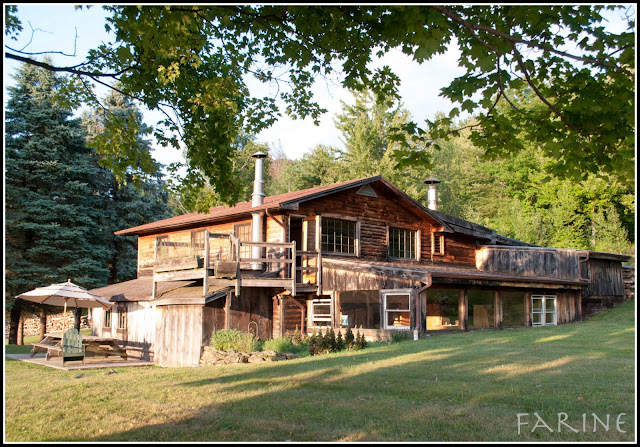
California Homemade Food Act in 2012. Thanks to his relentless statewide efforts, California "cottage food operators" no longer need a commercial license to sell what they make at home. There are constraints, of course. For instance Mark cannot use the beautiful wood-fired oven he built in his backyard in
Los Feliz to bake any bread he sells through a store or a
CSA. He must use the stove in his home kitchen.
But he still uses his outdoor oven when he bakes for family and friends, and I was lucky enough to see him operate it on the day I visited. Whether baked in the backyard or in the kitchen, Mark's bread is made with the same simple ingredients: organic white flour, organic grains which he mills himself into whole-grain flour, sea salt and distilled water. He currently bakes about twenty loaves a week: miche, levain and rye. The miches are 70% fresh whole grains (hard red winter wheat, hard red spring wheat, spelt and rye), the levain 30%. The rye is 40% whole rye and 60% wheat. All are leavened with natural starters, all gorgeously rustic, healthful and flavorful. Just the kind of bread I can never get enough of!
I followed Mark with my notebook and pen as he unwrapped tray after tray of proofed loaves and carried them outside to his oven. He was in a bit of a rush because the oven had reached the perfect temperature (550°F/288°C near the dome, closer to 500°F/260°C near the sole) and the bread was clearly ready to bake. But I walk fast and scribble even faster, and he didn't appear to mind my shadowing him back and forth.
As seems to be the case with so many people I have met in the bread world since I began this series, Mark didn't start out to be a baker. He actually still makes his living as a consultant for non-profit organizations. He attributes his lifelong love affair with bread to the fact that he became a vegetarian when he was still in high school. His mom supported his decision as long as it didn't entail her cooking two sets of meals a day, one for him and one for the rest of the family. So he ate whatever he could and soon became bored with his diet. Once in college, he decided to start cooking for himself, using The Vegetarian Epicure, by Anna Thomas. The book offered a recipe for French bread.
Mark decided to give baking bread a try. The rest is history. The
Vegetarian Epicure was followed by Julia Child's
Mastering the Art of French Cooking whose chapter on baking provided him with years of inspiration and learning. He even built himself the simulated baker's oven Julia advocates for serious home bakers. From there he moved on to Carol Fields'
The Italian Baker and finally decided to focus on traditional French country bread. He started grinding his own flour, took a class with
Jeffrey Hamelman, discovered
Gérard Rubaud (through this blog, I am delighted to say) and now relies on his own
levain à la Gérard. Along the way he also built an
Alan Scott oven in his backyard with the help of a friend (it took them four months, working on weekends, figuring out each step of the way)...
...won a couple of blue ribbons for his bread (LA County Fair, 2005; California State Fair, 2006)...
...and finally realized that he might as well bake to sell since he now had an excellent and roomy oven. By then it was 2008, and Mark had already acquired quite a reputation in his neighborhood as a homebaker. He didn't have to go far to find outlets for his bread: the cheese stores in nearby Silver Lake and Echo Park were only too happy to carry it. The word spread.
Food bloggers found out. More people asked for his bread. He started selling to a CSA. Soon he was baking fifty to sixty loaves a week and working non-stop mixing, proofing, shaping and baking Thursdays through Sundays. "Informal apprentices" came every week to watch and learn.
Alerted by the online buzz,
the Los Angeles Times expressed an interest. Mark explained to the reporter that the stores which carried his bread were not authorized to sell homemade food products; he didn’t want to get the owners in trouble. If the reporter went ahead with the article, she couldn't say where his bread was to be found. A week before the story ran, she called saying they had to let the people know where to get his bread: “We’ve done this before. Don’t worry!”
The
story was featured in the June 2, 2011 print edition of the paper. The next day, inspectors from the LA County Health Department descended on the stores. As it happened, Mark's bread was already sold out in both places and the inspectors didn't find any. But at one store they made the owners throw away cheeses which were kept at room temperature for ripening and at the other, they started going methodically through the inventory. Seething, one owner started a huge battle with the Health Department. Whatever the outcome, Mark knew he could no longer sell his bread.

Crushed for a couple of days, Mark quickly realized it was in his best interest to make friends with the Health Department. So he called them up, innocently asking about baking bread at home and whether it was legal to sell homemade food in California. There was a long pause on the phone... and then the answer came: "Is this Mark Stambler? What were you thinking?!", the Health Department inspector asked. He then said that while it was illegal for Mark to sell bread he baked at home, it would probably be fine for him to sell wholesale bread he baked at a certified bakery or catering kitchen. Mark started asking local caterers and bakeries if he could use their ovens, and when two said "yes", he double-checked with the Department to make sure it would indeed be okay. The retail side of the Department said "yes" but the wholesale side said "no". It took a year to get the issue sorted out: it turned out that in LA County, a bakery couldn't legally do both wholesale and retail in the same location. Mark called bakeries all over California to find out if other counties had the same restrictions. They didn't. All over the place, bakeries were happily mixing wholesale and retail sales.
What about the bagel stores in LA? Mark drove to the
Brooklyn Bagel Bakery. The owner said they had always been selling wholesale and retail and got inspected by the LA County Health Department every year. Mark informed the Health Department who was speechless with surprise at the news. Through sheer single-mindedness, he managed to get through to the upper
échelons and, in 2011, the policy was changed. It became legal in LA County to do retail and wholesale in the same bakery.
But people still couldn’t bake bread, pies, cookies, etc. at home and sell them wholesale. It was legal in eighteen states (some states had had such laws for twenty years) but not in California. Mark googled "selling California homemade food"and learned of the Sustainable Economies Law Center (SELC), a group of Northern California young lawyers looking to fight whatever regulation was stifling community-building in the state. Mark explained the situation, SELC agreed that a law needed to be written and Mark started looking at how to write laws. Then, late in the summer of 2011, just when it became clear to Mark that he hadn't a clue how to write and pass a state law, Mike Gatto, his representative in the California state legislature, called out of the blue and asked what he could do to help.
Mark worked with Gatto’s staff and SELC through the rest of 2011 on drafting the text of the law. Then he spent the best part of 2012 lobbying for it in Sacramento and visiting scores of assembly members and state senators (he says he now has a lot of respect for what legislators do). Working with SELC, he started an online petition, got thousands of signatures and managed to generate a lot of publicity and public interest. The Assembly and the Senate approved the bill towards the end of summer and Governor Brown signed it into law on September 21, 2012. It became effective on January 1, 2013. A couple of days later, Mark became the first person in LA County (and possibly in all of California) to be able to sell homemade food legally. The stores and the CSA started carrying his bread again.
Mark sees the legislation as a stepping stone: it gives people who are starting out a way to try their hand at the business. If successful, they can expand and go commercial. Mark himself is thinking of opening a bakery with a wood-fired oven one day. When he does, I hope he'll invite me to come back down and visit. Bakeries have got to be my favorite stores. There is no headier fragrance that the smell wafting out of freshly baked naturally leavened loaves and few more comforting sounds than the crackling song of cooling bread. Photos and words are sadly inadequate in that respect...

You might think Mark had been busy enough over the past few years, working at his full-time job during the week, baking all weekend, lobbying legislators in Sacramento, gathering signatures and so forth that he had time for nothing else but collapse in bed when he had a chance but you would be wrong! In 2011, together with two friends and fellow bakers who attributed the scarcity of good bread in the LA area to the absence of a baking community in Southern California, he decided to even the playing field by creating the
Los Angeles Bread Bakers. By early 2012, the group counted more than 600 members throughout LA County, as well as elsewhere in California.
The members were lamenting the lack of local access to good organic flour and grain: Mark contacted Keith and Nicky Giusto from Central Milling, drove up to Petaluma and filled the trunk of his Honda Civic. Back in LA, he split his bounty with his fellow bakers.
Today LABB members order a couple of pallets at a time a few times a year (thus greatly reducing delivery charges), bulk-order baking equipment such as baskets, lames, whisks, etc., offer classes (oven-building, bread-making, soba-noodle making, tortilla-making, etc.) and lectures and, listen to this, grow grain themselves!
Yes, you read that right, LABB is trying its collective hand at raising different varieties of wheat and spelt in Los Angeles: of course it helps that one of the members has acreage in Agoura Hills and is letting the group farm some of it. I was supposed to go and see the fields on the day of my visit but we were in LA with our oldest granddaughter for her spring break and somehow I didn't get the feeling that a nineteen-year old college student's preferred activity for her last day in the city (she was flying back that night) would be a long drive to the hills to watch wheat grow. So we skipped the tour.
Fortunately LABB keeps a
blog and I have been following its farming adventures closely, especially the encounters with sheep and friendly pigs and the contest with the ground squirrels who apparently love good grain as passionately as bakers do. Mark visits the fields regularly and was warned by a local farmer against the large, aggressive rattlesnakes who patrol the area on the lookout for human intruders. As he put it in a recent email, "who knew that baking bread could be so hazardous?"
Who indeed? If one excepts the break-in by a big raccoon one night as loaves were cooling in the screened porch at our little cabin by the River, my only baking encounters with wildlife have been with the yeasts which leaven my bread: they may have a mind of their own but they are not threatening.
Mark kindly sent me home with three loaves of bread, the first "real" bread we had had in the week since we had left home. What a treat! With Danielle gone, we couldn't possibly eat it all, so we took it with us when we drove to Escondido the next day to visit my friend
Mimi whose family owns and operates an avocado ranch (which is so beautiful that I'll share a few photos in another post). Mimi was delighted with the bread (from what she said, I got the feeling that good bread isn't easy to come by where she lives) and as we were hungry, she set out to create a simple snack.
She sliced some of Mark's bread, cut open and sliced an avocado, added a few drops of Meyer lemon juice (she had picked the lemon as we visited the ranch), ground some salt and pepper over the whole thing and voilà, she was done. Silence reigned around the table as we chewed, mindful of the harmony in our mouths. I never knew the taste of levain could make an avocado sing... Bravo, Mark, and merci!